We were inviting people to an opening event. I gave AiREA a job I’ve spent ten years doing as a marketer: write an invitation that makes someone want to be there. I wanted to see how much engagement we could get from a newsletter produced entirely by AI, with me directing the campaign from start to finish.
The goal was specific. Someone reading the email should understand why the opening was worth attending, then be able to reserve a spot or add the event to their calendar.
The first step was cleaning the database.
Some addresses looked like bot signups. Others looked like someone had run a hand across a keyboard. I had AiREA flag suspicious entries and check them against the people each of us on the team had spoken with one-on-one. A strange-looking address is easy to flag. If a teammate had exchanged emails with the person who owned it, that was worth knowing before we removed it.
Then my bots imported the cleaned list into Brevo through its MCP connection. I’ve worked with Brevo for years. I like the platform, and it’s where I wanted to run the campaign. My bots handled the opt-in settings and checked which contacts had agreed to receive our emails. A prior conversation could help us recognize an address. Consent determined whether that address belonged on the mailing list.
One event, two audiences
I segmented the list by geography. Language was the obvious reason. The more interesting one was how to extend the invitation. What would I actually say if I were inviting someone from each market in person? A translation can be accurate down to the last word and still sound like something you’d never say to the person reading it.
That thinking went into the brief. I chose the content blocks, their order, the photos, and the calls to action. “Reserve a spot” and “Add to calendar” serve different moments. One reader might be ready to commit. Another might be interested enough to save the date. I wanted both of them to have an easy next step.
“By the time my bot opened Claude Design, I’d already decided what I wanted the reader to understand, feel, and do.”
One AiREA bot then handled the entire build. It designed the newsletter in Claude Design, converted it to HTML, created the GIFs, and assembled the finished email directly in Brevo. We sent it in two batches.
What the numbers say
| Open rate | Click-through rate | Click-to-open rate | |
|---|---|---|---|
| First send · 275 emails delivered | 43.64% | 18.55% | 42.50% |
| Second send · 126 emails delivered | 52.38% | 57.94% | 100% |
| MailerLite’s 2025 median · 3.6 million campaigns | 43.46% | 2.09% | 6.81% |
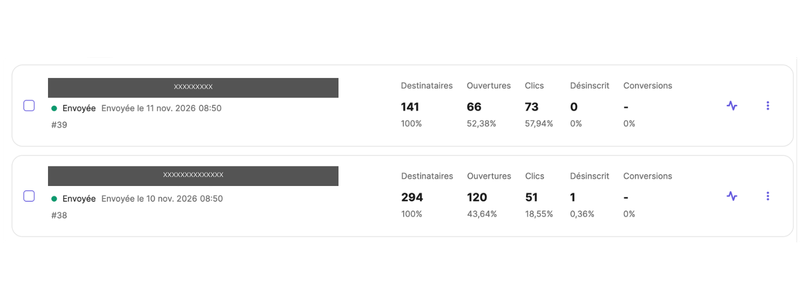
If you don’t spend your mornings in an email dashboard, the difference is the denominator. Open rate tells you how many delivered emails registered an open. Click-through rate tells you how many registered at least one click. Click-to-open rate compares the recipients who registered a click with those who registered an open. On the first send, Brevo recorded 51 recipients clicking. That’s 18.55% of the 275 delivered emails, or 42.5% relative to the 120 recorded opens. Brevo’s guide to campaign metrics
For some perspective, a typical campaign in MailerLite’s dataset registered about 43 opens and two clickers per 100 delivered emails. Our first send was right around that opening benchmark. The second came in almost nine percentage points higher. The recorded click-through rates were what caught my attention. Both were well above the benchmark, even allowing for the fact that we were inviting a small, targeted list to the opening. MailerLite’s 2025 email marketing benchmarks
On the smaller send, Brevo recorded 73 recipients clicking and 66 opening. To see how many of those clicks led to a reservation, I’ll need the registration data.
Where the ten years come in
What struck me when I looked at the finished newsletter was how much of my judgment I could see in something AiREA had produced entirely on its own. The email was beautiful. The photos and GIFs gave it movement. The copy sounded like an invitation I’d actually extend. And the reader had a clear reason to click.
That’s where ten years in marketing showed up. In the data I chose to give the system. In the cultural context behind each version. In a prompt specific enough to explain why a block belonged above the reservation link. I decided what deserved a yes, what needed another pass, and when the email was ready to send. AiREA carried those decisions all the way into the inbox.
And luckily, I added UTM tags to the links before we hit send. They’re little labels in a URL that let me trace a visit back to the email and link it came from. I’m building the tool to track those visits now. The part I want to see is how many ended in a reservation.
I’ll tell you what happened after the click in a future Behind the Build. 😉
Behind the Build — a series on the philosophy, decisions, and thinking behind building AiREA.
Continue the
conversation.